

15 min read
Best UK Web Hosting for Small Businesses: Comparison & Reviews
 Taya Grao-Randall: Apr 28, 2026, 12:32:01 PM
Getting your business online shouldn’t be harder than the work you’re already doing. Whether you’re a one-person setup or managing a team, you need a website that actually loads when people click on it, doesn’t crash every other day, and doesn’t sting you with hidden fees once you’ve signed up.
There are loads of hosting companies out there chucking around buzzwords like “unlimited” and “lightning-fast”, but most small businesses don’t need all that noise. You just want a website that works, support that answers when you need help, and pricing that doesn’t double after the first year.
This guide breaks down the UK hosting providers that are actually worth looking at, the ones that keep your website running, don’t mess you around, and offer real value for what you’re paying. I’ve looked at the setup, the support, the sneaky fine print, and whether they’re any good once you’re past the flashy homepage.
Here’s the good, the bad, and the overpriced, so you can get a clear picture of who’s worth your money to get your business off the ground with your business site.
Tl;Dr: Best UK Web Hosting For Small Businesses
If you don’t want to read the full guide, here’s a quick summary of the best UK web hosting providers for small businesses:
- Best all-rounders: SiteGround and Krystal for reliability and support
- Best for beginners: Bluehost and Hostinger (easy setup, lower cost)
- Best performance: Rocket.net (fastest, but premium pricing)
- Cheapest option: IONOS, but watch for renewal hikes and contract terms
- Biggest pitfalls: Hidden costs, upsells, and long-term lock-in contracts
- Top tip: Always read both positive and negative reviews before choosing
The best UK web hosting providers for small businesses include SiteGround, Krystal, Hostinger, Bluehost, Rocket.net, and IONOS, each suited to different budgets and needs
Best UK Web Hosting Providers For Small Businesses (Comparison Table)
| Host | What It’s Good At | Price (Starting)* | Support | Ideal For | Downsides |
|---|---|---|---|---|---|
Easy setup, great for beginners |
~£2.50/mo |
Friendly but can be slow |
Anyone starting out on WordPress |
Renewal price jumps, pushes upsells |
|
Super fast, secure, fully managed |
~£30/mo |
Very responsive |
Growing businesses who want speed + simplicity |
Pricey, WordPress only |
|
Simple dashboard, good value |
~£2.50/mo |
Mixed reviews |
Small sites needing cheap, reliable hosting |
Slower on busy plans, support can be patchy |
|
Strong performance + support |
~£2.99/mo |
Excellent, UK-based |
Sites that need to stay online 24/7 |
Big jump in renewal costs |
|
Cheap start, phone support, all-in-one bundle |
~£1/mo |
Inconsistent |
Simple sites needing basic hosting & email |
Awkward cancellation, sneaky charges |
|
 Krystal Krystal |
UK-based, green energy, good support |
~£5/mo |
Solid + friendly |
Small UK businesses who care about support |
Slower during busy times, dashboard is a bit clunky |
-b8cf816e-785f-48ee-9bfd-e193922246ca.png?width=301&height=77&name=Rocket-Logo_(8)-b8cf816e-785f-48ee-9bfd-e193922246ca.png)


While we're focusing on the best options for our UK audience here, providers like SiteGround, Hostinger, and Rocket.net are global powerhouses. If you're based in Mainland Europe, the US, the UAE, Australia, or beyond, these are still fantastic options for your business."
Please note: When you purchase through links on our site, we may earn an affiliate commission. Find out why.
Table Of Contents
Why Choosing the Right Hosting Provider Matters for Small Businesses
Think of web hosting like the foundation of a house. Doesn’t matter how nice your website looks, if the hosting’s dodgy, the whole thing can fall apart in spectacular fashion. A good, reliable host keeps your site online, loads it quickly, and ensures people can actually find you when they search for what you do.
If your site’s slow or crashes a lot, you’ll lose potential customers before they even see what you offer. And if search engines like Microsoft and Google see your site as a mess or keep going offline, it won’t show you high in search results, which means fewer calls, fewer jobs, and less money in your pocket.
Reliable hosting also helps with security. It’s what keeps your site safe from hackers and weird spam. You don’t want your website getting hijacked or blacklisted because your hosting provider cut corners.
Solid hosting isn’t just for tech geeks. It’s one of the simplest ways to make sure your business looks professional, gets found online, and doesn’t scare people off with long load times or error messages.
Key Features Small Businesses Should Look for in a UK Hosting Provider
Choosing a web host can feel a bit technical, but it doesn’t need to be complicated. There are a few key things that make all the difference, and they’re easy to spot once you know what to look for.
Speed & Uptime
Your website needs to load fast and stay online. If it’s slow or keeps dropping out, people will click away and probably won’t come back. A decent host will keep your site up and running smoothly around the clock, no weird delays, no outages when you need it most.
Speed and reliability also affect your visibility on search engines like Bing and Google . A slow website, or one that fails to meet Core Web Vitals standards, can hurt your search rankings, meaning your site may not appear as prominently in search results. In short, better hosting can improve both user experience and SEO.
-Apr-28-2026-11-04-03-6852-AM.svg)
A slow website doesn't just frustrate users, it can also impact your search rankings
Customer Support
When something goes wrong, and let’s be honest, at some point it probably will, you want support that’s quick, helpful, and easy to understand. A good hosting provider should offer responsive customer service from real people who can actually solve problems, not just send automated replies.
Look for hosting companies with a strong reputation for support, ideally offering multiple contact options such as live chat, phone, or email. The best providers will help you resolve issues quickly, rather than leaving you stuck in endless email chains or going round in circles with AI chatbots.
Scalability
As your business grows, your website should be able to grow with it. Whether you’re adding more pages, taking online bookings, or attracting more visitors, your hosting needs to handle the extra demand without causing problems.
The best hosting providers make it easy to upgrade your plan as your needs change, without requiring you to rebuild your site or deal with unnecessary technical hassle.
It’s also worth thinking ahead when choosing a provider. Moving from shared hosting (the entry-level option) to a private server or dedicated hosting can sometimes be a difficult and time-consuming process if your host doesn’t offer those options. In some cases, switching providers altogether may be the only solution, which can be disruptive and expensive. Pricing can also increase significantly as you scale, so it’s important to understand the long-term costs before you commit.

If you are collecting customer details or taking payments it is essential you have a high level of security on your website.
Security
Even small websites can be targeted by hackers, bots, and other malicious activity. A good hosting provider should handle the essentials, keeping servers secure, backing up your data regularly, and blocking suspicious traffic before it causes problems.
Ideally, security should work quietly in the background so you don’t have to think about it, but it’s important that those protections are in place.
Some hosting providers also include extra security features, such as malware scanning, firewalls, SSL certificates, or website security plugins. Others may offer support if your site is ever compromised and needs to be restored.
Before choosing a host, check exactly what security tools and backup options are included, so you know what level of protection you’re getting.
Pricing Transparency
Watch out for the sneaky stuff. Some hosts look cheap upfront, then sting you with hidden fees, pricey renewals, or extras that should’ve been included in the first place. You want clear pricing, no smoke and mirrors, and a plan that won’t blow your budget a year down the line.
Pick a host that ticks these boxes, and you’ll save yourself a lot of grief later.
Why Researching a Host is Vital
Before signing up with a new hosting provider, it’s worth doing a bit of due diligence and looking past the flashy offers. While switching hosts is usually possible later on (as long as you’re not tied into a long contract), moving your website isn’t always seamless.
Changing servers can sometimes cause temporary disruption. Your site may go offline for a short period during DNS propagation, when your domain updates to point to the new server. This can take anywhere from a few hours to a couple of days.
On top of that, your website may need to be reconfigured to work properly on the new server, especially if different software versions, settings, or security rules are in place. In some cases, you may temporarily lose access to important services, such as business email, while everything is being transferred.
One of the most important things to do before choosing a host is to check reviews. Guides like this are designed to share our experience as a digital marketing agency, but every business has different needs, and experiences can vary.
When researching reviews, look at multiple sources. Don’t just focus on the glowing five-star ratings; some companies actively encourage or incentivise positive reviews. Take time to read the negative ones too. These often highlight recurring issues such as poor customer support, hidden fees, performance problems, or difficulty cancelling and moving away.
Keep an eye out for warning signs such as rigid contracts, steep renewal pricing, and complicated migration processes.
A hosting provider could be something your business relies on for years, or even decades, so it’s worth taking the time to choose carefully. A little research now can save you a lot of hassle, downtime, and unexpected costs later.
.svg)
Five-star reviews can be reassuring, but always dig deeper. Read both the positive and negative feedback to spot genuine experiences and uncover warning signs like rigid contracts, hidden fees, or poor support.
Best UK Hosting Providers for Small Businesses
1. Bluehost

Strengths
Bluehost is one of the big names in hosting, and for good reason. It’s easy to use, especially if you’re just starting out, and their customer support gets a fair amount of praise for being friendly and helpful. They offer one-click WordPress installs, making it simple to get a site running even if you’re not very technical. Prices start low, making them suitable for anyone watching their budget.
Ideal for
Small businesses want affordable, beginner-friendly hosting that covers the essentials without overcomplicating things. If you’re using WordPress but don’t need anything fancy, Bluehost works well.
Pricing
You can get plans for as low as £2.50 to £3.50 a month for the first term, which is good for starting out. Just watch out for the renewal rates, they jump up quite a bit after the first contract. That’s pretty standard but worth knowing.
Drawbacks
While support is generally helpful, some users report long wait times during busy periods. Performance is okay for small sites, but if your traffic grows, you might find their shared hosting can slow down. Also, upsells during checkout are common, so be careful you don’t accidentally buy extras you don’t need. Email hosting is included, but some find the interface a bit clunky compared to newer providers.
2. Rocket.Net
Strengths
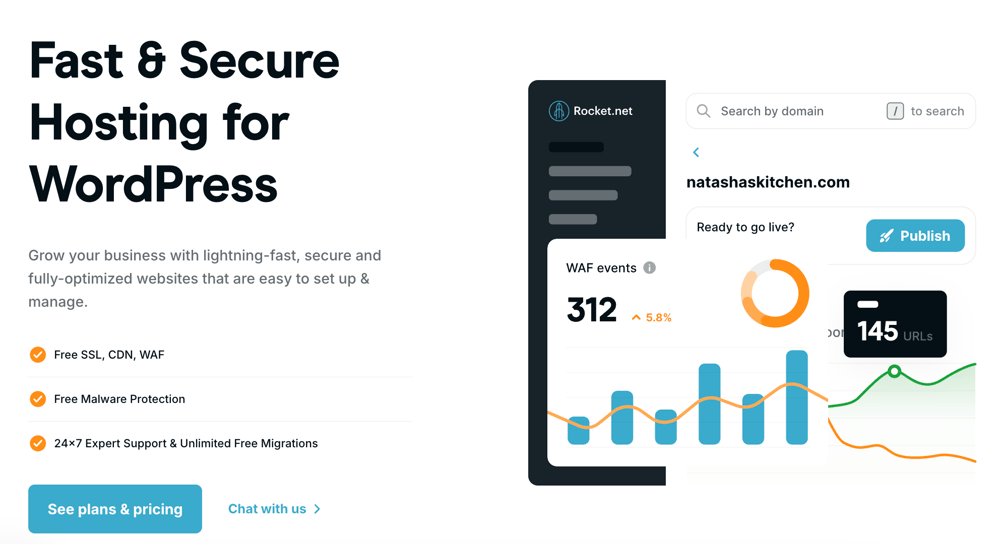
Rocket.net focuses on speed and simplicity. They use a global content delivery network (CDN) to make your site load fast wherever your customers are. Setup is user-friendly, and they handle all the technical stuff for you. Security is strong with automatic backups and malware scanning included.
Ideal for
Small businesses that want fast, reliable hosting without messing with complicated settings. It’s especially handy if you run a WordPress site and expect your visitor numbers to grow.
Pricing
Rocket.net isn’t the cheapest on the block. Plans start at around £30 a month, but that price includes premium features such as a CDN and managed security. No sneaky add-ons here; everything you need is bundled in.
Drawbacks
The main downside is the price, which might be too steep if you’re just starting out or running a very simple site. Also, they focus heavily on WordPress hosting, so if you’re not using WordPress, it might not be the best fit.
3. Hostinger
Strengths
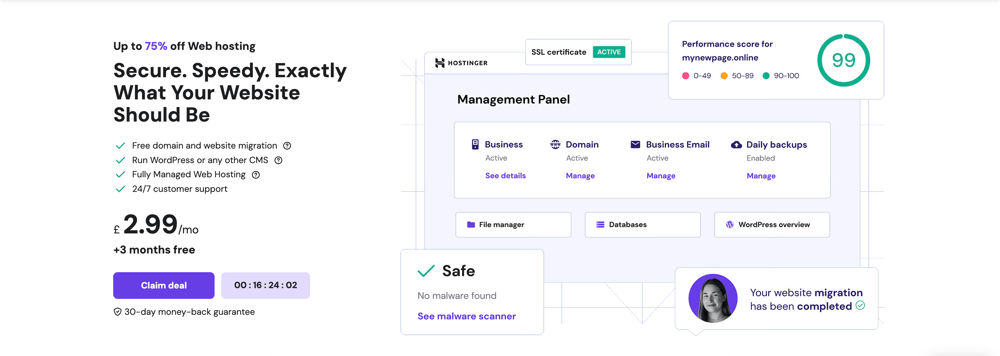
Hostinger’s biggest win is how fast and easy it is to get set up. The dashboard is clean and straightforward, with no confusing menus or weird tech terms. I had a basic site up and running in minutes, and everything worked without a fuss.
Speed-wise, it’s solid. Pages load fast, and the site stays online reliably, which is what you want if you’re using it to bring in jobs or show off your work. You also get handy extras included, like a free domain name, daily backups, and basic email hosting, all bundled into the price.
Ideal for
If you’re running a small business or trade and just want a good, affordable home for your website without getting lost in the tech side of things, Hostinger’s a solid option. It’s reliable, it doesn’t cost the earth, and you don’t need to be an IT wizard to figure it out.
Pricing
Starting around £2.50 a month if you sign up for a year or longer, making it one of the cheapest options. But like others, prices rise when it’s time to renew.
Drawbacks
The support is a bit hit-and-miss. Sometimes they’re quick and helpful, other times it feels like you’re stuck waiting for ages. Also, if your website grows or starts getting a lot of visitors, you might notice things slowing down a bit on the cheaper plans. And while they do give you email accounts, the inbox setup feels a bit clunky—it works, but don’t expect anything fancy.
4. Siteground

Strengths
SiteGround feels reliable from the start. It offers strong performance, excellent uptime, and daily backups, so if something goes wrong, you’re not left scrambling to restore your site.
One of its biggest strengths is customer support. Unlike some providers that simply point you toward help articles, SiteGround’s support team is responsive and genuinely helpful when problems arise.
At LoudLocal, we use SiteGround as the primary hosting provider for some of our own clients and have found the service consistently excellent.
Hosting plans include the essentials you’d expect, such as free email accounts, built-in security features, and performance tools designed to keep your website loading quickly, even during busier periods.
Ideal for
If your business relies on your site being online and running smoothly, whether it’s to take bookings, show off work, or just look professional, SiteGround is a safe bet. Especially good if you think you’ll grow over time and want something that can handle more traffic later on.
Pricing
Starts at about £2.99 a month on longer plans, but jumps to around £15 a month after the first year. The price hike is steep, but the quality justifies it.
Pricing for dedicated hosting can increase significantly, but they do make the costs visible to users.
Drawbacks
The biggest downside is the renewal pricing, which can catch people out if they’re only looking at the introductory offer.
If your site becomes busier, especially if you’re running paid ads or seeing sudden traffic spikes, you may be encouraged to upgrade sooner than expected. That’s not necessarily a bad thing, but it’s worth factoring into your long-term budget.
Also, if you’re moving from another hosting provider, SiteGround’s migration tool isn’t always the smoothest experience. Some users may need extra help to transfer everything over successfully.
5. Ionos

Strengths
What stands out to me about IONOS as a UK web host is how affordable it is to get started. You get a free domain for the first year, an SSL certificate, and email hosting, all bundled in. The dashboard is clean and straightforward, which makes setting things up simple without wrestling through pages of confusing settings. Support is available 24/7 over the phone, which is handy if you prefer talking things through rather than reading through help articles.
Ideal for
If you’re a small business needing a simple, low-cost solution that covers domain, hosting, and email in one place, IONOS hits that mark. It’s especially useful if you want straightforward service and aren’t planning to scale to a large size or rely on many plugins or custom setups.
Pricing
Introductory prices start incredibly low, sometimes as low as £1–£2/month when you sign up for a year or more. But renewal pricing can jump significantly, so it’s worth checking what you’ll pay after the first term ends.
Drawbacks
A few quirks came up during testing and from real user reports. The control panel, while clean, isn’t as fast when loading files or navigating; some tasks took noticeably longer than on other hosts. Support is solid over the phone, but live chat can be hit-or-miss; sometimes it’s unavailable or slow to respond. Cancelling can often be a hassle, too.
My takeaway: IONOS offers a low-cost entry point and covers the basics well, especially if you want email, domain, and hosting all in one. But if you value easy cancellation, speedy backend performance, or plan to scale usage later on, there are better options out there with fewer surprises.
6. Krystal

Strengths
Krystal stands out for being a UK-based host that’s serious about good service and eco-friendly hosting. Their servers run on 100% renewable energy, which is a bonus if sustainability matters. The control panel is clean and easy to use, setup is hassle-free, and speed and uptime are reliable. Support is consistently praised and available via phone, chat, and email.
Ideal for
Small businesses and tradies who want dependable UK hosting with a greener edge. It’s perfect if you want good support, easy setup, and don’t mind paying a bit extra for eco-friendly servers. Great if you want straightforward WordPress hosting too.
Pricing
Plans start around £5 a month, which is a little higher than some budget hosts, but you get decent features included, like free daily backups and free SSL. They don’t lock you into long contracts, so monthly billing is available.
Drawbacks
Krystal isn’t the cheapest option out there, so if you’re looking for bare-minimum budget hosting, it might not be for you. Also, some advanced features aren’t available on the lower-tier plans, which means if you want more control or resources, you’ll need to upgrade.
My takeaway: Krystal’s a solid choice if you want local UK support, green hosting, and reliable service without any fuss, just be ready to pay a bit more for the extras and peace of mind.
Things to Watch Out for (Fine Print, Upsells, and Limitations)
Web hosting companies love to make things sound simple and cheap upfront, but there’s often a bit of smoke and mirrors going on behind the scenes. Here are a few common traps to keep an eye on so you don’t end up paying more than you expected, or stuck with a service that doesn’t do what you need.
Too-Good-to-Be-True Pricing
Some hosts lure you in with a rock-bottom monthly price, but that rate only applies if you pay for two or three years upfront. Then, when it’s time to renew, the price suddenly jumps. Always check the full ongoing cost, not just the first-year discount.
Limits on “Unlimited” Plans
You’ll see many plans that claim to offer unlimited storage, traffic, or email accounts. But when you dig into the fine print, there are limits. If your site uses more resources than they like, they’ll slow it down or try to push you onto a more expensive plan.
Pushy Upsells
It’s common for hosts to try to sell you a bunch of extras you might not need, like extra security, backups, or email add-ons that should really be included in the first place. Be wary of checkout pages stacked with optional charges you didn’t ask for.
Basic Support That’s Not So Helpful
Some hosts offer “24/7 support”, but it turns out to be a chatbot or an overseas helpdesk that sends you copy-paste replies. If you’re not techy, you’ll want proper support from people who actually help when something goes wrong, not just a ticket system that takes days.
Low Resources on Cheap Plans
That entry-level plan might be tempting, but it could come with very little storage or slow loading speeds once your site’s live. If your site starts to grow or you add more features, you could quickly hit those limits and be forced to upgrade.
Long Contracts with No Way Out
Some hosting companies lock you into long contracts with no refund if you change your mind. Make sure there’s a clear cancellation policy and check if they offer monthly plans or short-term options while you test them out.
My Takeaways
If you don’t want to compare every feature in detail, here are the main things to know:
- Cheapest to start: IONOS offers the lowest entry price, making it a good option for tight budgets. Just be aware of potential price increases at renewal and cancellation quirks.
- Best customer support: SiteGround and Krystal stand out for responsive, genuinely helpful support rather than simply directing you to help articles.
- Best speed and performance: Rocket.net is one of the fastest options, but it comes at a premium price. Hostinger and SiteGround offer strong performance at a lower cost.
- Easiest for beginners: Bluehost and Hostinger make getting started simple, with beginner-friendly dashboards and one-click WordPress installs.
- Green hosting: If sustainability matters to you, Krystal is the standout UK-based eco-friendly option.
- Watch out for renewal price shocks: Bluehost, SiteGround, and IONOS all increase prices after the initial term, so check long-term pricing before signing up.
It’s also worth noting that website builders such as Wix and Shopify include hosting as part of their service. For some small businesses, this can be a more cost-effective and straightforward option. However, if your website and hosting are tied to the same provider, moving away later can be more difficult.
Final Thoughts
Web hosting shouldn’t be a guessing game. You don’t need to understand every technical detail, you just need a provider that won’t let you down when your site gets busy or when something goes wrong.
The options in this guide all do the job in different ways. Some are fast and fuss-free. Some are cheaper but come with compromises. Some offer hands-on support, while others expect you to know your way around the technical side. The key is choosing the one that fits your business needs, not just the one with the flashiest homepage.
If you’re just getting started, choose something reliable with good support and a simple setup. If your business is growing quickly, look for a host that can scale with you. Either way, it pays to read the small print and avoid getting caught out by hidden costs or overblown promises.
And if you’re not sure which option is right for you, or you’d like help setting up your website for speed, SEO, and long-term growth, LoudLocal can help. We’re a digital marketing agency that works with local businesses on everything from websites and hosting to SEO and paid advertising, so if you need advice, just get in touch.
This guide is here to save you time and hassle. No jargon. No hype. Just the things that matter when your website needs to work, plain and simple.
At LoudLocal, we’re committed to helping local businesses discover the best tools, products, and services to grow and succeed.
Within our blog content, we may include links to products and services from third-party providers for which we can receive compensation, known as an affiliate fee, if you click those links or make a purchase. This affiliate fee is paid to us by the provider and does not directly affect the price you pay.
Our blog team operates independently. This means the products and services featured in our articles, guides, and recommendations are selected based on unbiased editorial judgement, relevance to local business owners, and the value they provide. While our team may use commercial insights to better understand the market, our priority is always to deliver independent, objective, and genuinely useful advice to small and local businesses.

 Leon Hidderley

 Rhys Langdon