

10 min read
Why conversion tracking is vital for paid advertising performance
 Leon Hidderley: Oct 19, 2026, 7:45:05 PM
Your ads are getting clicks. The budget is being spent. But which campaigns are actually bringing in customers?
If you cannot answer that confidently, conversion tracking is a good place to start.
At LoudLocal, we run campaigns across LinkedIn, Google, Microsoft, Reddit, Pinterest, ChatGPT and Meta. One observation keeps coming up: campaigns with limited tracking tend to struggle to meet their goals.
That does not mean every poorly tracked campaign produces poor results. Sometimes sales or enquiries happen, but the advertising account cannot see them. Either way, it makes improving the campaign much harder.
It is a bit like asking someone to improve their darts while keeping the board behind a curtain. They can keep throwing, but useful feedback would probably help.
What is conversion tracking?
A conversion is an action you want someone to complete after interacting with your ads. That might be a purchase, a completed enquiry form, a booked consultation or an event registration.
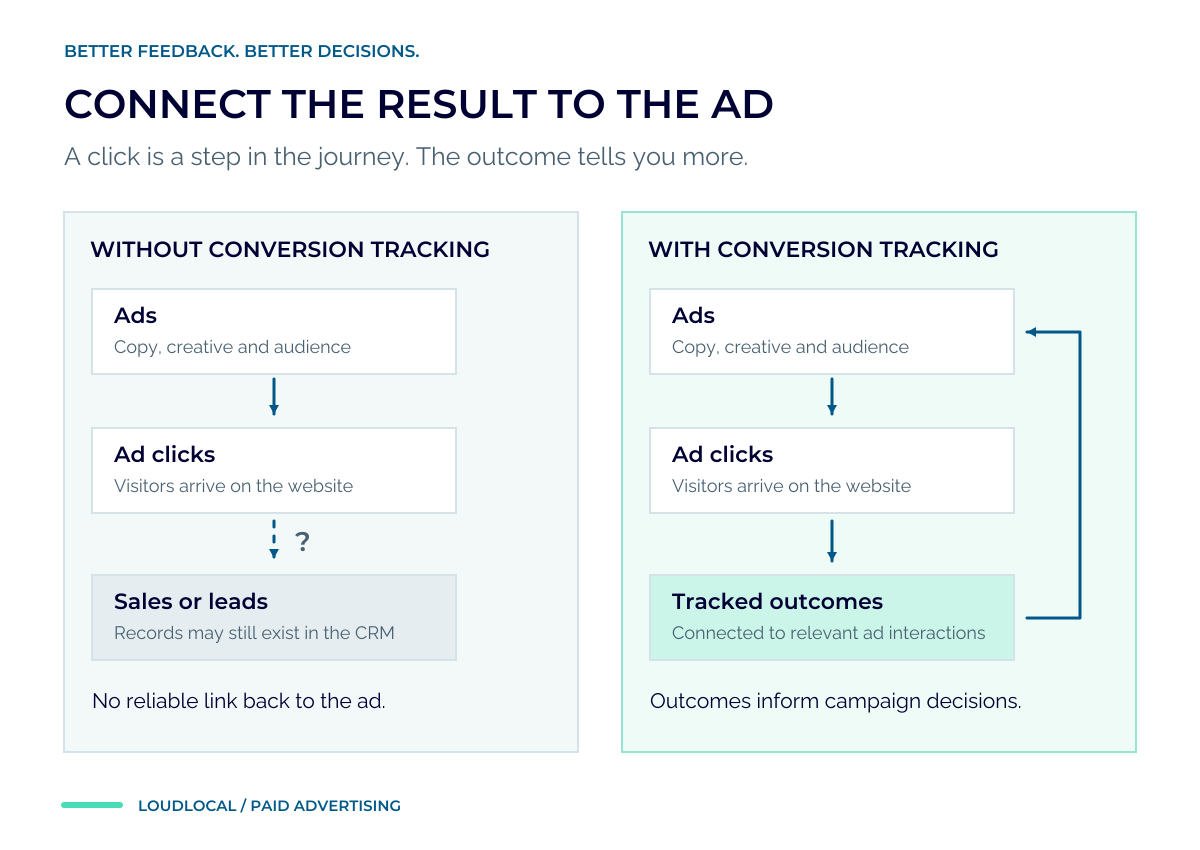
Conversion tracking records what action the user took and, where the available signals allow, whether it relates to an ad interaction (such as clicking a link). It helps answer two different questions: what happened, and which advertising contributed to it?
A visit to your contact page is different from a successful enquiry. A click on “register” is different from a completed registration. Choose the action that reflects your business goal, rather than the easiest button to count.
Why do campaigns with limited tracking often struggle?
The platform has less useful feedback.
Conversion-focused advertising systems use outcome data to help decide which opportunities to bid for. Google’s Smart Bidding documentation, for example, explains that its strategies optimise for conversions or conversion value.
If genuine enquiries never reach the account, or a page view is treated as a sale, the feedback doesn't accurately reflect success. The campaign may have less evidence to learn from, or be encouraged to take an action with little business value.
Tracking also needs the right campaign objective. A campaign configured to attract clicks is being given a different task from one configured to generate leads. Adding a purchase event does not automatically change that objective.
You have less evidence for budget and creative decisions
A low cost per click can look encouraging. It tells you very little about whether those visitors became suitable customers.
Once you can connect ads with completed actions, you can compare cost per enquiry, lead quality and sales value. You have a stronger basis for deciding which message, audience or landing page deserves more attention, and where spend may be wasted.
For businesses with longer sales cycles, that means looking beyond the first form submission. A campaign producing lots of unsuitable leads can look excellent until someone checks what happened in the sales team.
The customer journey can disappear between systems.
An ad can sometimes send someone to your website, who then clicks on a form which is not hosted on your website (e.g. if you use a third-party event tool, such as ON24). Tracking the first page doesn't automatically mean you track the full journey.
You can end up with registrations in the event platform and clicks in the ad account, but struggle to see how they are connected. So to be sure everything is working as intended, it's suggested you check embedded forms, external checkouts and confirmation steps as part of the same journey.
UTM parameters (the labels you add to campaign links) help identify campaign traffic in analytics or your CRM. They do not, by themselves, send a completed conversion back to the advertising platform.
What does better tracking look like in practice?
A trade business: from 249% to over 1,400% ROAS
For a builders’ merchant we work with in the trade and construction sector, our year-on-year comparison of Google Ads activity showed return on ad spend (ROAS) increasing from 249% in August 2025 to over 1,400% in August 2026. The monthly advertising budget was £500.
The original Google Ads conversion tracking was not working. We used Google Analytics to determine sales attributed to paid advertising, then set up working conversion tracking and enabled Consent Mode v2. We also used remarketing to reach previous site visitors, put a cookie policy and consent management platform (CMP) in place, and supported the client with GDPR considerations.
That work helped us direct spend more effectively and reduce waste. Remarketing was another part of the approach; reaching previous visitors still needs the appropriate consent and privacy controls.
In plain English, that is a change from £2.49 to more than £14 in reported conversion value for every £1 spent on advertising.
This was a combination of changes, rather than a controlled test of tracking alone. The original tracking fault and use of Google Analytics also matter when interpreting the comparison. Better tracking can change how much existing revenue is attributed to advertising, so the ROAS increase should not automatically be treated as the same increase in actual sales.
For a clearer picture, compare advertising figures with actual orders or results in your CRM, using consistent dates and measurement settings. ROAS measures conversion value against ad spend, but it doesn't account for product costs, agency fees, or other business expenses to show profit.
A professional services organisation: cost per lead from £149 to £84
For a professional services organisation we work with, setting up lead tracking gave us more than a count of enquiries. We could use those completed leads as a signal in future campaigns to help with targeting.
The overall cost per lead fell from £149 to £84, a reduction of approximately 44%.
That is the practical value of connecting the outcome back to the advertising: what you learn from one campaign can help inform the next. It is still important to check whether those leads are suitable for the business, rather than judging success on cost alone.
How do you set up conversion tracking properly?
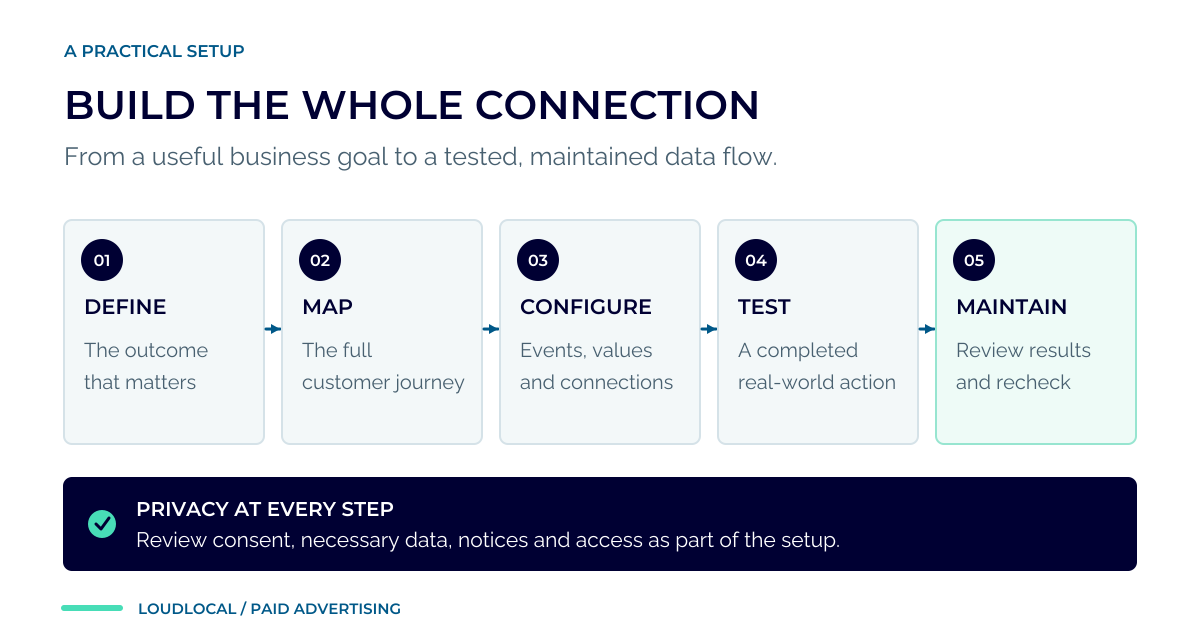
1. Agree what success means
Start with the result you want to achieve and then work backwards. So for an online shop, that may be a completed purchase with its value and what currency is used. For a service business, it may be a quality lead or a confirmed appointment booked into the diary.
Useful supporting events, such as when someone adds things to the basket, can help explain the journey. They should not accidentally become the main measure of success.
In Google Ads, review the primary and secondary conversion settings and the goals each campaign actually uses. Primary actions in a selected standard goal can guide bidding; secondary actions normally support observation. Custom goals are an exception, so check the configuration rather than relying on the label alone.
2. Map the systems and assign an owner
Write down where customers start their journey, where the conversion happens, and where the final record lives. Include the website, consent tool, forms, checkout, event system and CRM where relevant (practically everything).
Agree who can change each system and who will maintain tracking afterwards. Keep the business in control of its accounts and access. My guide to who owns your ad accounts explains why that matters.
3. Choose an integration that suits your website
You may worry about how much this will cost to implement, but there's good news on this front. Many modern website platforms offer official apps, plugins and partner integrations that can simplify the technical work:
- Shopify: the Google & YouTube channel includes a Google Ads conversion-tracking setup route.
- WordPress: Google’s Site Kit plugin conversion tracking integrates with supported form and commerce plugins. Check that your particular plugin and required action are supported.
- WooCommerce: Google for WooCommerce includes Google Ads conversion measurement. Review existing tags before enabling another integration.
But even without an official integration, AI tools may be able to guide you through setting this up based on your needs. Check their suggestions against the platform's official instructions. If you have an in-house developer or an agency with the right experience, they can help with the setup. And having a second pair of eyes to check things afterwards certainly can't be a bad thing.
4. Connect completed actions to the ad account
A browser tag or pixel is a small piece of code that sends events (recorded actions) from the visitor’s browser. A server connection, often called a Conversions API, sends events from your website platform, server or another connected system.
Depending on the platform, using both can improve measurement coverage. If both report the same purchase, configure deduplication, which means making sure the same purchase is only counted once. Avoid counting a Google Ads purchase tag and an imported analytics purchase as two separate bidding outcomes for the same order.
For longer sales journeys, look at connecting your CRM or sending later sales back to the advertising platform. These are often called offline conversions. You can then report leads your sales team has checked are suitable, or sales they have completed, rather than just the first form submission. Set this up with the same care over permission and data use as website tracking.
5. Test the completed journey
Make a test purchase, submit a test enquiry or complete a registration. Confirm that the event appears in the platform’s diagnostics and the expected record reaches your business system. A test event being received does not necessarily mean it will be attributed to an ad click.
Check the event name, value, currency and unique event or transaction ID. Refresh the confirmation page to confirm the same action isn't counted again. Test mobile devices, external forms and consent choices, including rejection and withdrawal.
Recheck after website releases, plugin updates, form changes or changes to your consent tool. Tracking is something to maintain, rather than a box to tick once.
What tracking does each advertising platform offer?
It may seem overwhelming at first, mainly because every platform uses a different name for its conversion-tracking setup. However, the important thing to remember is that they're all trying to do the same job: connect an ad interaction with the action you want someone to take. The technical setup and data rules can still differ. I've added a few links below for some of the official guidance for each of the platforms:
| Platform | Official guidance and tracking options |
|---|---|
| Google Ads | Enhanced conversions can supplement existing conversion measurement with eligible first-party data (information collected directly from your customers). |
| Conversion tracking includes the Insight Tag, imported conversions and Conversions API routes. | |
| Microsoft Advertising | Universal Event Tracking (UET) supports website conversion measurement through configured goals. |
| Reddit’s campaign setup guide covers its Pixel and Conversions API. | |
| The Pinterest tag measures website actions, with a Conversions API option available alongside it. | |
| ChatGPT | OpenAI’s conversion measurement guide explains the OpenAI Pixel and Conversions API for ads in ChatGPT. |
| Meta | Meta for Business’s setup walkthrough explains the Meta Pixel and Conversions API. |
Options and eligibility can change. Check the documentation and the features available in your account before choosing an implementation.
What about cookie tracking and GDPR?
Cookie tracking can help connect an advertising interaction with a later action. Pixels, tags and other technologies may also store or access information on a visitor’s device.
For UK visitors, this brings in the Privacy and Electronic Communications Regulations (PECR), alongside the UK GDPR where personal data is involved. The rules extend beyond technologies labelled “cookies”, as the ICO’s guidance on storage and access technologies explains.
The ICO is clear that advertising tracking requires consent, including measurement associated with that advertising. It should not be treated as strictly necessary just because your business wants to measure a campaign.
Your consent tool (sometimes called a CMP) should give people a clear choice, with an equally simple way to reject or accept, and a way to withdraw consent if they wish. Test that ad cookies wait for consent and don't sneak through when consent is declined; otherwise, you may leave your brand exposed. The ICO’s practical consent guidance shows what that involves.
One thing that can catch people out is that Google's Consent Mode isn't a consent management platform (CMP), so you still need a way to ask visitors for consent and manage their choices. A CMP can help with that. Advanced implementations can send cookieless pings when consent is denied, so review what is sent rather than assuming “cookieless” means no data collection. Ask the person setting it up to explain which approach they're using and what happens when someone says no.
What data can you share with an advertising platform?
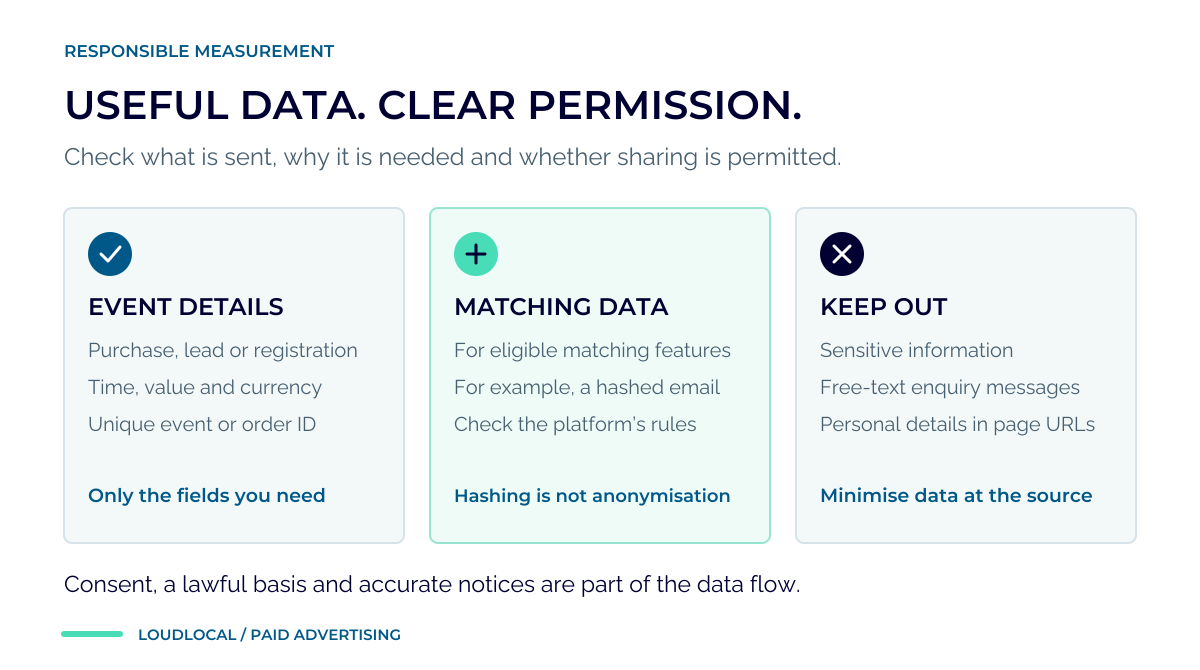
Depending on the integration and permitted use, a conversion event may include the action taken, its time, purchase value, currency and an event or transaction ID. Leads, purchases and registrations can all be useful outcomes to measure.
Some matching features also use personal data. For example, Google enhanced conversions can use hashed first-party customer details such as an email address. Supported fields and processing requirements vary by platform.
Hashing changes the format of information. It does not automatically make it anonymous or remove your responsibilities: the ICO distinguishes pseudonymised data from anonymous data.
Share only what is necessary and permitted. Review automatic matching settings and the fields you configure manually. Keep sensitive information, enquiry messages and personal details in page URLs out of advertising events.
Update the notices and review the actual data flow
Your cookie policy should explain the advertising technologies used, their purposes and durations, and how visitors can manage their choices. Your privacy notice should explain relevant personal-data processing and sharing, including purposes, lawful basis, recipients, retention, rights and any international transfers. The ICO’s right-to-be-informed guidance sets out what people need to know.
Updating a policy alone does not automatically give you consent. Check platform terms, access controls, and applicable data-sharing arrangements, and involve your privacy lead before enabling customer-data matching. A server connection also needs this review; moving data away from the browser does not make the underlying processing exempt.
For campaigns reaching other countries, check the local requirements too. We can support the technical setup and help you work through GDPR considerations, but we are not solicitors. For advice specific to your organisation, consult your Data Protection Officer (DPO), if you have one, or a suitably qualified legal representative.
Your conversion tracking checklist before launch
- Outcome: have we determined what counts as a conversion? (e.g. filling in a form)
- Journey: have we covered external forms, bookings and checkouts?
- Connection: does the completed action reach the correct ad account and the CRM or order system?
- Accuracy: are any values, local currencies, counting rules and duplicate events correct?
- Campaign: is it using the intended objective and conversion goal?
- Privacy: do consent choices work, and do the notices describe the real data sharing?
- Ownership: does someone know how to test and maintain the setup?
Once the campaign is running, compare platform reports with your business records. Different attribution windows (the periods in which platforms credit ads with a sale or enquiry), reporting delays and multiple platforms claiming influence can produce different totals. Do not simply add every platform’s reported sales together and assume they are unique orders.
Reliable tracking will not fix an uncompetitive offer or a difficult landing page. It will give you a much better chance of finding out what needs to change.
If you are unsure whether your campaigns are measuring the right things, speak to the LoudLocal team. We can help you review the journey, understand the gaps and plan the next steps. You can also explore our paid advertising services.
If you're still getting to grips with paid ads, our PPC guide for smaller businesses is a useful place to start.

 Mia Deeming